
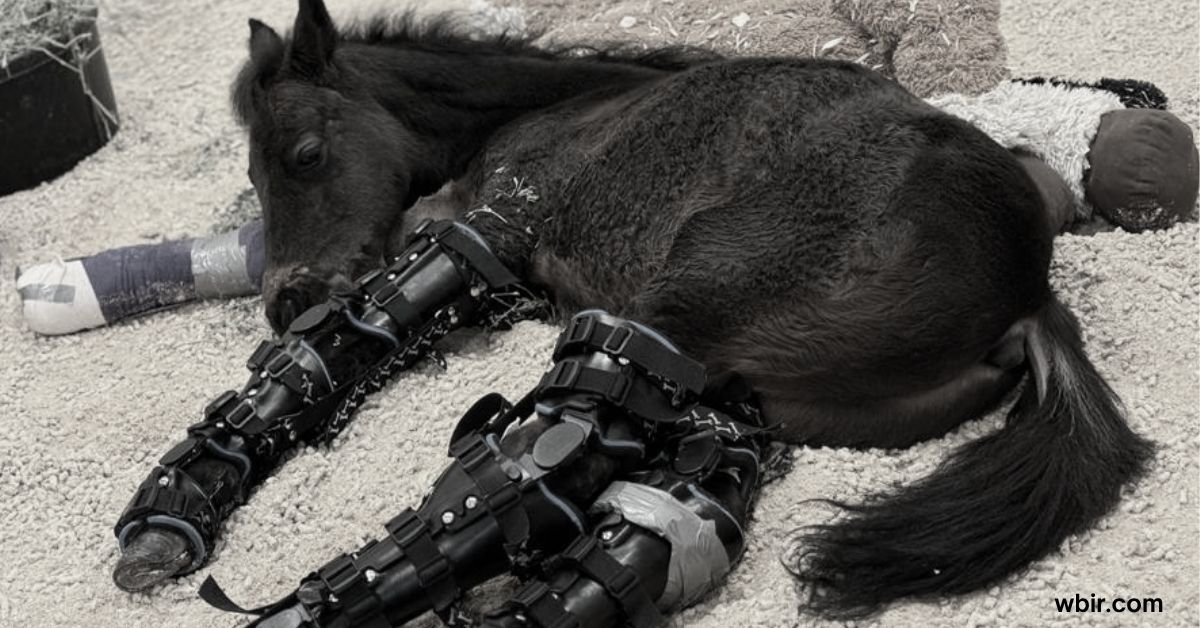
Last year, the euthanasia of an 18-month-old foal called Seven due to colic became worldwide news in the equestrian community, because of the large amount of social media coverage that surrounded his short life. This was on account of his severely premature birth, at just 286 days’ gestation, and subsequent ‘battle’ at the University of Tennessee College of Veterinary Medicine.
I first noticed this story earlier in the same year. I’m the first to admit that I’m not one for short-form socials, which is probably why I came to this story late in the day.
Seeing past the miracle factor
Social media channels do not reward innocuous stories with coverage – it is the highly positive or highly negative story that achieves virality, and this story had plenty of both. At the most positive end, Seven was considered a miracle foal and you don’t get much more positive than that. It’s a term that always generates a huge emotional and optimistic response.
The coverage was not always accurate – for example, it was stated that foals born before 310 days’ gestation are considered unviable, which is not correct. This error was carried through to the university’s own magazine articles. On the good side, veterinary updates to camera were provided by Dr. Tena Ursini, a clinical assistant professor of equine physical rehabilitation heading his treatment team.
My position might be a little different to many of those who engaged with his story. Researching a syndrome of gestational immaturity has certainly given me insight into longer term consequences – and no, that’s not always optimistic.
The arc of a premature foal’s life is not established with their condition after the initial survival or ‘miracle phase’ if you will. In such under-developed foals, the early days are often a true fight, with multiple organ dysfunction common. That said, it’s a veterinary emergency that is increasingly being won through the advances in veterinary medicine.
Seven’s story brought other factors to the forefront.
Making the big decisions
Should barely viable foals, usually born earlier than 300 days’ gestation, be given extensive treatment as neonates?
On a general level, vets will always present owners with the range of treatment options available at a particular point in time and their likelihood of success. If there is one very clear ‘best’ option, strongly supported by research findings and previously observed outcomes, they will still do this.
If a severely premature foal is critically ill and almost certain not to survive, this will be made clear. If survival is possible and one or more treatment options remain open, this will also be made clear. The expression of likely outcomes can be one way in which the vets gently try to help an owner recognise the choice that is in the animal’s best interests. This is when matters are less black and white.
For owners, though, options often ARE black and white. The only right thing to do is try to save the foal that they love. The emotional drive is strong: everything must be done, no question about it.
The decision for Seven
It is worth considering the veterinary intervention that took place with this foal. Seven is interesting because it seems he had sufficient organ maturity at birth to escape the need for emergency interventions beyond a plasma transfusion and prophylactic antibiotic therapy. No critical decision-making was required.
And with funds available for treatment – enough to fund a later scholarship with the surplus – his owner was not faced with the financial limitation that stops many from going ahead. This enabled a no-holds-barred orthopedic approach that was imaginative and somewhat experimental in nature, this being a new scenario for those involved.
There were certainly bumps in the road, including an infected fetlock joint at 6 months that led to surgical fusion (fetlock arthrodesis), apparently after a team quality of life discussion (owner update including vet statement here). Those moments were faced and addressed.
As the treating team said regarding that decision to continue: “…if the animal’s all in and the owner’s all in, there’s really no reason why we as the veterinary team can’t be all in, with realistic expectations.” [1]
With realistic expectations. I can’t help but notice the qualifying nature of those words.
Absent joint development
In Seven’s case, this left the not inconsiderable orthopedic issues associated with incomplete ossification – most likely a Grade 1 on the Skeletal Ossification Index, defined as ‘some cuboidal bones with no ossification’.
The treating vets will have (must have?) known that the foal’s limb issues could once more become complicated over time. Even if relative straightness could be achieved in the very young foal, it is extremely difficult to maintain equilibrium during the coming months of growth and activity.
Yet this was an owner choice, made in a grey area with no imminent decision about humane options. Many foals can and do succeed in having a comfortable enough paddock life, despite having angular limb deformities.
The College of Veterinary Medicine reported that with Seven, they were dealing with “a tricky combination of joint laxity, joint contracture, angular limb deformities, and incomplete ossification – conditions UTCVM had treated in isolation in plenty of older foals and horses, but not in conglomeration in one very young animal.” [1]
BUT foals have energy and vitality that shines through whenever possible – they are not ‘fighting’ and are not doing well simply because they can spring about and zip along. It’s just what they do, whenever they can.
Persistent angular limb deformities
As time went on and Seven went home, the videos seemed to be a little selective in the editing. This kind of thing becomes obvious when you’re trying to see a particular element.
Another hint is present in owner Katy Van Slyke’s statement after the foal had passed. “While we knew that we didn’t have years or even many months left with our sweet boy, we had hoped for more sunny days of watching him graze in the pasture.”
It is genuinely moving. I do understand how distressing it must have been to put so much into saving a foal only to see either a slowing of improvement or a general decline. But, if anything is to be gained from this foal’s life through a contribution to knowledge, facts are essential.
Suffice it to say that the story being presented likely did not quite align with the reality, even if by omission. This is the nature of social media, of course, where pictures are often painted with broad brushes. “It’s like a story of perseverance, and so I think a lot of people can find a really good feeling from that and hope from that,” his owner said in one interview, when he appeared to still be on an upward arc.
For huge numbers of people were watching (over 4 million of them) and, so they believed, learning from his story.
Persistent angular limb deformities
For me, it was always going to be those hocks. I had a case study in my research cohort that had hindlimbs like this. Even following surgery for tarsal valgus, the angular limb deformity continued to worsen. Then the imbalances it caused impacted on her overall posture to the point that she developed horrendous arthritic changes in all four legs – and her spine, as she was so asymmetric. She came into my sphere at the age of six and was euthanised at eight years old.
For even when the horse ‘only’ has retarded growth at maturity, the type and build, and therefore weight, can impact on the compromised joints. She was a Warmblood, which Seven clearly was not. As a Quarter Horse, he was starting to look heavier as he approached 18 months of age. These foals may be shorter at maturity, but they do still show breed type – I have seen it with a Shire youngster born at less than 300 days.
Conformation also plays a part here, and straighter hindlimb conformation is not positive when combined with compromised distal tarsal bones.
The upshot is that bone continues to change according to the pressures it’s subject to, and limbs that were previously improving may suddenly worsen as the youngster gains weight. I go into this in depth in my book.
Associated ‘sleeper’ conditions
As I established through pilot studies in my PhD, there are multiple causes of problems affecting bone and joint health.
Poor bone mineral density is a huge possibility – maldevelopment of the adrenal gland cortex in premature foals may well affect production of aldosterone and compromise the Renin-Angiotensin-Aldosterone System (RAAS) that in turn affects calcium regulation. This leads to bone becoming more porous, and therefore weaker.
And weakened bone is more vulnerable to remodeling.
It is never simply about straightening crooked legs and allowing a foal to grow through delayed bone development. They certainly can’t all just catch up with this level of underdevelopment at birth.
Hindsight and judgement
In the aftermath of Seven’s passing, much social media commentary comes from one of two camps: those for and those against his being kept going. It’s a foal euthanasia debate. The word ‘hindsight’ is bandied around quite regularly in these discussions.
Foal maturity is always individual, being only roughly guided by that number of gestation days. Seven is the embodiment of that: how he was viable is anyone’s guess and only nature knows the answer. Therefore my response is that if we’re not there to see the foal, witness the treatment, see test results and hear discussions, we don’t know.
However, I will definitely tend towards a very cautious viewpoint, given the likelihood of complications that emerge later.
What we do know is that 10 surgeries were performed during his short lifetime. I’m sure this wasn’t planned, and some are minor while others are not. But it is a lot.
I have added a timeline here.
The ever-present research need
The Introduction to my thesis is preceded by a quotation from a paper written 10 years ago:
“Many early studies were retrospective and focused on general populations of sick foals. More current prospective and retrospective studies are identifying differences in various prognostic indicators based on primary diagnostic categories, differences in management techniques, and changes in various indicators with time.” [2]
We need to do better at understanding these issues and be mindful of a syndrome of gestational immaturity. Seven’s case is rare and is likely to remain so, given the unique factors contributing to the nature of his treatment. The vast majority of foals born at that stage of gestation will not make it.
There is talk of a research paper and I look forward to reading it for accurate, objective details on this case. I suspect it will be an assessment of the effectiveness of the treatment and rehabilitation used, and that will be valuable, even in helping to define what can and cannot be achieved.
I hope it is clear on his late-stage orthopedic condition, regardless of the colic that drove the final decision to let him go.
Final thoughts
Much is made of Seven’s legacy. I am personally left with two lines of thought.
First, returning to those words ‘with realistic expectations’, I have to wonder what these were. Measures to mitigate Seven’s extreme limb deformities were always going to be frontier treatment – achieving a certain level of functionality for the foal through great treatment didn’t, to my mind, provide any suggestion that this would be maintained in the growing horse.
Second, the idea that a foal’s will-to-live is the reason for continuing. Foals have energy and want to move – so often, this is seen as ‘fighting’. Should decisions about quality of life be left until the light dies in the eyes and the animal gives up completely? Euthanasia on the basis of what might happen tomorrow, or next month or next year is a fundamental ethical question.
It is possible that in the end, the final decision during a colic episode may have been colored by how the 18-month old was already doing. Was it one struggle too far? His prematurity may or may not have been a factor in that illness, or it may simply have been one of those devastating episodes that can apparently hit any horse out of the blue.
Ultimately, there are discussions here and for sad reasons, much to learn. I will end with the dedication in my book:
“To the ones who make it through, and to the ones who don’t, but who stop by to teach us instead. I hope your visit will not have been in vain.”
[1] Estep, S. The Legacy of Seven. Torchbearer, the magazine of the University of Tennessee. https://torchbearer.utk.edu/2025/09/the-legacy-of-seven/
[2] WILKINS, P. A. 2015. Prognostic Indicators for Survival and Athletic Outcome in Critically Ill Neonatal Foals. Veterinary Clinics of North America: Equine Practice, 31, 615-628.